Truth, Lies, & Gossip

Trust Issues? Me? Nah. How about you?

I suspect most, if not all, adults have trust issues. Human beings can be deceptive and deceitful; uplifting topic no? Unfortunately, gossip and minding other people’s business are also some of our glorious and not-so-attractive traits.

The “who cares what people say” attitude is admirable; however, not my truth. Therefore, the best I can do is find a way to navigate the current landscape. By the way, I’m as guilty as the next guy when it comes to telling white lies; however, 9 out of 10 times, it’s either to save someone’s feelings or avoid unnecessary conflict.

Short Story

I recently received a text from an individual who said he was coming to the Algarve for a short visit. He was wondering if he could stay with me for a few days. A couple of details factored into my reply: first, this was a friend of a friend I had spent five minutes with in New York, and second, I didn’t like him — you know one of those slick willies who tries to get you to invest in shit you have no business getting involved with. I told him I’d be away for a few weeks during the time of his visit. I gathered that he got the message because I didn’t hear back. This was a lie I didn’t mind telling.

It would be so much better to just outright say what we think, but it’s not the way our culture works; we thrive in a sea of lies.

What We Say to One Another

Have you ever told someone you had to get off the phone because you had an important call you had to take or make? Have you ever told a party host you had to leave because you had an early flight (your flight was at 3:00 p.m. the next day, for some people that’s early)? What about I can’t travel with you to Greece because I spent all of my discretionary income last month? I imagine these are lies we have all told at one point or another in our lives. These lies keep us from hurting feelings. Most of us know when it’s happening and just accept it as common practice. Then there is the knife in the back distortion of the truth or partial truth.

What I am talking about is deception among friends; the telling of untruths specifically meant to damage an individual’s reputation or standing. I’m going to use an example that cannot be traced back to one of my friends:

I’m sitting at lunch with Mary and she tells me that she heard that Mark is having an affair with Lilly; all mutual friends. My first response should be, “I don’t want to hear about it.” But because I’m human, my interest peaked. You know about this kind of gossip, it’s the worst. Is it based on speculation? Is someone jealous? Has someone been scorned and seeks revenge? There are so many different reasons people start these kinds of rumors. In truth, it’s unfair to everyone involved. If it’s a fact and someone is being deceived, that’s different. There are discreet and appropriate ways to handle these indiscretions, gossip or whispering behind one’s back, is not one of them.

For me there are two red flags when someone is about to share something inappropriate with me: 1) I’m telling you this because I care about you, and 2) it’s for your own good. You see a person once a week and she never asks you a single question about how you’re doing or where you’ve been, but then she cares so much about you, really?

This is a big one: We all know people who spend a great deal of time talking about mutual friends and acquaintances who are not present. Did you hear about so and so; I can’t believe he did that to her; she couldn’t possibly have that much money just sitting around; I’m sure they did it to look better than everyone else . . . call it gossip, talking behind someone’s back, spite talk . . . whatever it is, it makes you wonder what that person says about you when you’re not around.

I recently confronted an acquaintance about what she was saying when a friend was not in the room. Her reply was clever, but dubious: “Sally and I had it out on Thursday and told her I’d be asking around to verify her story; there is no other way to find out if what she was telling me was true.” If that isn’t a load of bullshit. At the very least, this person knows that I’m onto her. These days, I don’t spend a whole lot of time worrying about what individuals say when I’m not around; it’s out of my control and I trust people to consider the source. Your time and energy is better spent on positive and productive matters.

When I was married, 24 years old and working at a university on Long Island, there were three different rumors going around about older women I was sleeping with. I thought that was pretty funny considering I was spending so much energy hiding my sexual orientation.

What We Say to Others

What do you say to those you care about? Often, it’s what you don’t say:

  • You look really tired
  • Why isn’t Gary working yet?
  • You’ve been sick for a long time
  • Did Emma invite you to her birthday dinner?
  • Why did you buy that house?

Obviously questions you might ask that would make people defensive, seldom leading to open lines of communication.

Here are some things you might say to gain trust and respect:

  • Yesterday you told me you were feeling a bit down, how are you today? Do you want to talk about it?
  • If you don’t mind I’d rather you didn’t speak about Mark, he’s a good friend and I don’t want to betray our trust or tarnish our friendship.
  • Tell me about that restaurant ordeal; was it difficult to be at the table?
  • I’ve been noticing that you’re quiet lately; I just want to make sure you’re okay.
  • I just want you to know I’m here.

A friend recently said, “There is something I’d like to share with you, but you should know I’m not looking for answers or advice.” I heard her loud and clear and I respected her honesty.

Navigating the Absence of Trust

In my mind there are limited options for interacting with individuals you do not trust. You can work on building trust. This takes time and investment, but it could be worth the payoff. I think it’s important to go with your gut; if after a while you’re not feeling it, you should probably walk away or distance yourself — not so easy if it’s your sister-in-law or boss.

Then there are those who have earned your trust only to have it all collapse after a devastating incident. A good friend who sleeps with your husband, a sister who steals cash from your wallet, a friend who tells everyone something you shared in strictest confidence . . . difficult to regain trust after betrayal.

The last one I’ll mention is the one I struggle with most: You have someone in your life who says and does all the right things, but it’s all surface stuff. You crave substance, but it’s just not there. You constantly wonder if this person is hiding something or questions your discretion. You ask questions; however, the answers just don’t come. It’s a conundrum because you’re fully invested. This may be one of those times where you may need to examine your own life. Are you trustworthy; are you asking the right questions? Objectivity is difficult when self-examination is warranted. In cases like this, I engage with someone I trust; they will usually provide some solid advice or help me with the right questions. But once again, in the end walking away may be your best option.

A thought: I have recently discovered that a great deal of the anxiety I have related to this trust issue, is self-generated. In short, drama that I have either initiated or created. It’s so much healthier to step back and let things be. Stirring the pot or looking for problems that do not exist is unhealthy and unnecessary. Time to trust yourself and let life play out as it inevitably will. Forgive yourself Christopher.

For those of you who may be feeling guilty (ha) because you occasionally partake in small-time gossip: relax, we’re all (okay most of us) a little guilty of it. When people spread lies or damaging, unsubstantiated gossip, now that’s a different story (see aforementioned example).

“Trust takes many years to build, few seconds to break, and forever to repair.” ~ Invajy

Holding Onto Those You Can Trust

You know the expression, “I have your back?” When you discover that you have a family member or friend that always has your back, nurture that relationship; these kinds of friends are hard to come by.

A thought: Today’s political landscape makes candid conversation and trust very difficult. There are times when I can put politics aside; however, if it’s about personal freedom/rights, race, guns, sexuality, etc., all bets are off.

Enter email address for a free subscription — dropped in your inbox whenever a blog is published.

Future Travel

Basel, Switzerland coming up soon, Asia land & sea, end of October/November, Lyon, France for Christmas, South Africa land & sea in February, and Oslo, Norway July 2024. Finally, a visit to the Puglia region of Italy in the spring of 2025; it’s about time I visit the birthplace of my father.

Current State-of Mind

Super excited about Switzerland after two months of staying away from travel. Keeping it special and occasional, is the way to enjoy time away (for me). Other than that, body issues related to aging; sucks to get old, but as they say, “It’s better than the alternative.”

“You may be deceived if you trust too much, but you will live in torment if you don’t trust enough.” ~ Frank Crane

Please forgive any grammatical or typographical errors. No AI software used in the creation of this blog.

To Thy Known [sic] Self Be True and/or Big Fat Lies

Be the real you | Quotes & Writings by porijai pakhi | YourQuote

Disclaimer: I want to start by stating that my blog is not meant to be the answer to all of your problems or the world’s problems for that matter. I’ve been around the block a few times and I’ve learned some things and accumulated a few stories. Sharing with my readers is my way of letting you in and hopefully, allowing for some thoughtful contemplation. Needless to say, if you do not agree with my point of view, it might be better just to click delete or move on.

This Week

I’m on retreat in Estoi, Portugal for a few days. Estoi is a beautiful, historically rich town in the hills not far from my home. My stomach has been a bit jittery because of COVID-19, uncertain times, economic upheaval, to name a few things, and I thought it would do Paco and I some good to spend time in the country where there is little distraction. I’m surrounded by orchards, beautiful hills, and the Algarve sun. It’s a time for reflection and calming the nerves.

I can’t get my arms around this virus. Hearing about death and the destruction of lives on a daily basis is a lot to take in. I don’t want to turn it off and become detached — I don’t want to plunge into a deep depression either. Again, it’s about balance. Balance seems to be the most important lesson I have learned as I get older. Empathy is an essential part of being human; however, too much empathy for me, means anxiety. Like everyone else, I’m afraid of getting or spreading the virus. They say this is the new normal. Well I say, I don’t care for it.

What You See

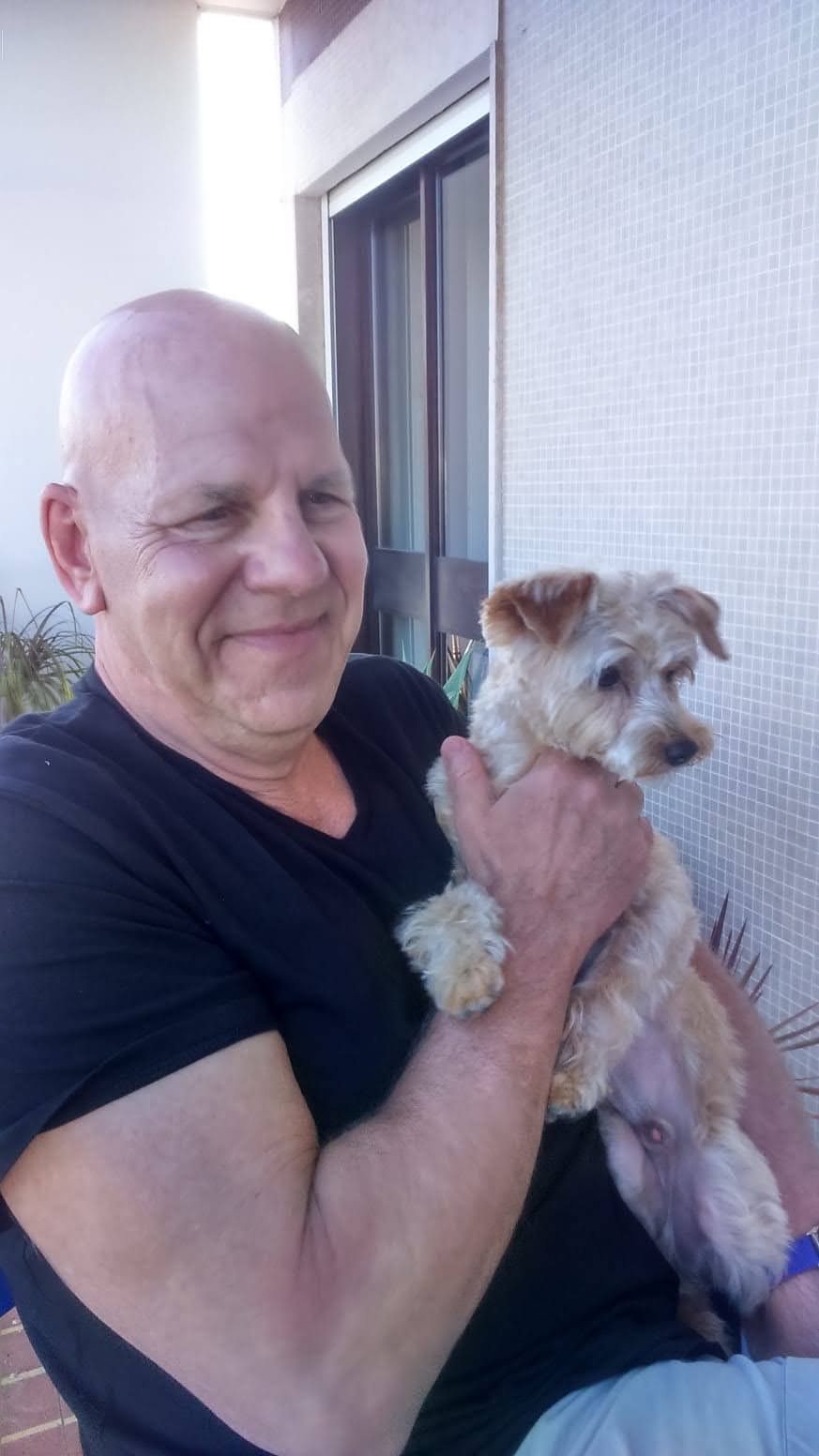
A recent photograph of Paco & me

Posting this photograph of myself is a bold move. When my friend Patricia took it a few weeks ago, I recoiled with disgust. She liked it, so she sent it to me even though I didn’t. I don’t like what I see at all. I know that I am 61 years old and no longer in shape, but honestly, I’d rather not look at it. I see someone who ate too much during quarantine and whose face is revealing far too much of just about everything I’m not too fond of. In my delusional mind, I’m young and still fetching. So here’s the dilemma: do I embrace the man you see in the photograph or do I continue to go along with what’s inside my head?

The answer for me is a little bit of both. I need to be grounded and aware of aging and be confident enough in my physical appearance to be comfortable presenting myself to the world. I certainly don’t want to look at a photograph of myself and give up. The good news is that after seeing this picture I decided to get rid of most of the sugar (the true killer) around my house and spend more time on the elliptical machine; fortunately, the pounds are starting to slowly disappear. There are so many things you can do to make yourself more attractive:

  • smile
  • dress well (even if you’re just going to the market)
  • go to the gym, walk, swim, run, hike, bike . . .
  • get a facial, haircut, massage — for yourself
  • have work done if it makes you feel better, but don’t over do it. Have you been to the upper east side in Manhattan lately? It’s a shit show of plastic surgery gone wild.
  • get a tan. Believe it or not, you can get a great tan with SPF 30
  • eat healthy foods
  • be with people who appreciate you for who you are
  • be around people who let you know when you are at your best
  • pay attention to your posture
  • remind yourself that earned every line on your face
  • take stock of the simple things
  • meditate
  • sleep and take an afternoon nap if you can
Photo by Lukas Rodriguez on Pexels.com
Photo by cottonbro on Pexels.com

Okay enough of this bullshit about me and my body. The bottom line is honesty with yourself and acceptance. Funny how those two things can change sometimes after a good night’s sleep or even better, after someone flirts with you a bit.

Please do not send me comments about how I look good in the above photograph. I hate the picture and no matter what you say, I will believe you are just trying to make me feel better. Either that or you love me so much when you look at me you only see a handsome guy. That’s all well and good, but it’s not what I believe to be true at the moment. Don’t worry, this too shall pass. Everyone gets a free pass on self-pity right now.

Being Less Than Honest With Myself and Others

Some would say that it’s healthy or natural to tell yourself little white lies — self-preservation. Like when you look in the mirror and you think, “You look good in these jeans.” That’s not a bad thing is it? I think it’s only bad if your lie hurts someone else. For example, a friend asks you what you think of her make-up after she does her face. You know in your heart she has put on too much and she looks like a clown and you don’t want to hurt her feelings, so you say, “You look perfect.” She walks around the entire day with people staring at her and even sometimes laughing under their breath. She might even do it the same way the next day thinking it looks good. In this case I believe gentle truth is the way to go.

“A little less eyeliner and not-so-much foundation might highlight your beautiful features.” Or

“Take a look in the mirror and tell me what you really think of your make-up?”

Let them see where they might have gone wrong. They might not always thank you at the moment, but that’s not what friendship is about.

On the other hand, if a friend says, “Do I look fat?”

No matter what you think, the answer is, “No, you look great.”

Two very different situations; one can be fixed, the other is much more complicated. There are nice/delicate ways to let someone know that they have put on a few pounds.

“Hey Sue, I have these COVID-19 pounds I need to shed and I was thinking of doing a long in the morning, want to join me? It would do us both some good.”

“Roger, if I recall your heart has been giving you some trouble lately; remember the slimmer you are, the better it is for your heart.”

“Hey sis, mom struggled with her weight once she hit 50; we have to be careful in our family.”

It’s all about a healthy balance, good mental and emotional health, and living with yourself.

The Problem with Denial

I know a lot of people who lie to themselves by denying the truth. The shaking your head constantly does make non-truth true, it only gives you a headache. I have found that facing the truth is often difficult for a short while, however, in the long run, you save a lot of worry and angst. For example, a few years ago I had a spot of my face that looked like a pimple, but it wouldn’t heal. I looked for pictures of it on the internet and what I saw and read frightened me. Pictures showed something similar to what I had on my face and the prognosis might be skin cancer. I put the thought out of my head immediately. Not possible with the type of skin I have, Mediterranean complexion after all.

When I was willing to look closely at the growth, I didn’t like what I was seeing. The spot was getting larger and darker and it was way too close to my right eye. After more than a year, I had it checked. Sure enough it was skin cancer. Fortunately it was basal cell carcinoma, easier to treat and less dangerous than melanoma. I had surgery to cut it; scarring was minimal and it hasn’t returned. Not taking care of it for so long made me anxious. I was worrying far too much about what it could be instead of just taking care of it. A situation where being honest with myself and having it checked right away would have saved me a whole lot of worry. I learned a big life lesson from this.

Human beings are very good about lying to themselves. We do it with big things and little things. Sometimes admitting the truth, although better in the long run, can happen too late. I don’t need to outline here what I mean. Let’s just say, be honest with yourself right from the start and you’ll be a great deal better off in the short and long run.

Quotes about Denying oneself (16 quotes)

What We Often Lie to Ourselves About

  • Alcohol abuse and alcoholism
  • Health
  • Extra weight
  • A relationship(s) that is unhealthy
  • Hating our jobs
  • Hating where we live
  • Our disposition
  • The company we keep
  • Finances

Is There a Solution?

I think there is: it’s called a tool box. We all need one at the ready; to tweak, fix, and overhaul. You need to yank it out whenever you start to doubt yourself or feel weak. Being human means being imperfect (sorry) and making mistakes. Knowing you have the ability to make an adjustment and move on, helps you to know things can and will improve. So if you begin to notice that you are having one or two more cocktails than you probably should, there are a few

tools you can use to get you to a better place (you can apply this tactic to many issues in your life):

  1. Admission is essential. You need to say out loud, “My drinking is a problem.”
  2. Come up with a plan to deal with the problem.
  3. Get some sort of help to insure that you stay on track.
  4. Monitor your progress daily.
  5. Enlist the help of a friend or expert.
  6. Take inventory of how addressing the problem has had a positive impact on your life.

The great thing about telling yourself the truth, is that you will begin to trust yourself. As in all relationships, trust is essential and necessary for success. If you want to love yourself, be true to yourself, and believe in yourself, you have to trust yourself; telling yourself lies will only lead to self-loathing and a downward spiral. Unfortunately, the further down that rabbit hole you fall, the more difficult it will be climb out and recover.

Living Life Without A User Manual : Be Honest With Yourself